
No book has made me cry like The Bluest Eye has.
I was a teenager, for starters: I read Toni Morrison’s debut novel the summer before my freshman year of high school, mere weeks before she passed that August. I couldn’t tell you what compelled me to pick it up, but I must have finished it in one or two sittings. To brusquely summarize, The Bluest Eye is a tragedy centered around a young dark-skinned Black girl named Pecola, who is thrown about by the forces of poverty, trauma, familial abuse, racism, and colorism as well as ableism. Pecola’s father Cholly rapes her and she subsequently becomes pregnant, then loses the baby soon after it is born. By the end of the novel, she is a town pariah and completely dissociated from reality.
The book is mostly narrated by Pecola’s adoptive sister Claudia, who takes the last pages of the book to mourn just how totally Pecola was failed by every person in her life, white and Black alike, herself included:
“The soil is bad for certain kinds of flowers. Certain seeds it will not nurture, certain fruit it will not bear, and when the land kills of its own volition, we acquiesce and say the victim had no right to live. We are wrong, of course, but it doesn’t matter.”
From beginning to end, Pecola’s biggest wish is for blue eyes. Not light skin, necessarily, but blue eyes. I am fascinated by this distinction on Morrison’s part. While there are several phenotypical indicators of whiteness or proximity to whiteness, the eyes are unique for their optic nature: obviously, we use them to see. To be blue-eyed is not only to be white, but to possess a white point-of-view in the most overt fashion possible. To take on the white gaze and be able to use it against others as well as oneself.
Claudia invokes the tremble-inducing power of the gaze explicitly in this last section as well, in coming to understand Cholly’s violence as an act of love, for as terrible as it is:
“Wicked people love wickedly, violent people love violently, weak people love weakly, stupid people love stupidly…There is no gift for the beloved. The lover alone possesses his gift of love. The loved one is shorn, neutralized, frozen in the glare of the lover’s inward eye.”
It is no wonder Pecola grasps blindly at a blue-eyed ideal of herself in a gesture towards self-possession and autonomy. What Pecola actually ends up being is scapegoated by her community, subject to the worst fate an animal-as-metaphor can get:
“Her simplicity decorated us, her guilt sanctified us, her pain made us glow with health, her awkwardness made us think we had a sense of humor. Her inarticulateness made us believe we were eloquent. Her poverty kept us generous. Even her waking dreams we used—to silence our own nightmares.
And she let us, and thereby deserved our contempt.”
Sima Farshid probes the “panoptic mechanisms” of the “Blue-eyed” in depth, as “American billboards, newspapers and cinema comparatively function like ‘a supervisor in a central tower’ that controls the mindset of all Americans by spreading the codes and standards of the dominant discourse.” Early on in the story, Pecola is given “a blue-and-white Shirley Temple cup” and proceeds to “gaz[e] fondly at the silhouette of Shirley Temple’s dimpled face.”
Pecola looks at Shirley, and Shirley–rather, the hegemonic ideal that Shirley represents gazes back. The consequences are immediate and corrosive.
As Pecola’s peer, Claudia does not aspire to emulate whiteness, but to deconstruct it, destroying white baby dolls and grappling with the impulse to do the same with living white and light-skinned girls “to discover what eluded me: the secret of the magic they weaved on others. What made people look at them and say, ‘Awwwww,’ but not for me?”
In desperation to escape her tumultuous and abusive home life, Pecola “asks God to make her disappear from that hellhole [and] succeeds to make every part fade away except her eyes.” As Farshid explains, “her imagination does not help her get rid of her eyes, as they identify her as an ugly, abject black girl.”
The eyes have always had it. The eyes, to paraphrase a popular saying, are the synecdoche of the soul. We are paradoxically defined by our relative permeabilities, and the eyes are unique for not only being a site of tactile sensitivity (smoke in ‘em) but a site of discourse reproduction as well.
Pecola wishes for “the bluest eye in the whole world.” The invocation of the singular eye alludes to the relationship between one’s gaze and one’s identity in a fashion that resembles Emily Dickinson’s propensity to use the eye as a stand-in for the personal pronoun. What it also does is drag the eye from the category of innate bodily trait to that of a displaceable and fungible totem.
I’m interested in that magic, that glamour, that intrigue or fascination provoked by white girlhood and femininity that Claudia is able to name explicitly and Pecola debases herself in pursuit of. The word fascination, actually, derives from the Greek fascina, a word that refers to the the evil eye.
As Leticia Aracil explains, “The evil eye belief and practice holds that the eye is an active organ that, intentionally or unintentionally, ‘emits destructive emanations charged by negative dispositions (especially malevolence, envy, miserliness, and withheld generosity)’ [that] can be avoided or repelled through a variety of practices or methods, including words, physical gestures, actions, and amulets.”
If you’re reading this, you’re probably familiar with the nazar, if only from a lot of white girlies putting the eye-bead emoji counterpart in their IG bios. Pelin Karslı explains how “in Turkish culture, the word nazar comes from Arabic origin meaning ‘to look,’ but at the same time..means a ‘touching eye’ that causes damage to whatever the subject lays eyes on. Thus, this eye goes beyond looking: it targets, approaches, touches, and even causes spiritual distress on those struck by the evil eye.”
The idea of a neutral (not-evil) gaze belongs to those who have no reason to believe they might be either at risk or at fault. I am writing this in November of 2025, and most of our biggest and baddest villains have no compunctions about operating in full view of the sun. But it’s not them I’m really trying to take to task here so much as it is, like, the most annoying white person you or I know personally.
I mean, they’re probably a narcissist? Whatever that still means? According to psychoanalyst Carlo Bonomi, it is “in certain states of regression when the boundaries between the self and the others are fading away [that] the gaze is..experienced as a disembodied force that radiates from the eyes and can dangerously penetrate into the mind.”
“Before knowing that we are visible, we feel ourselves as visible,” Bonomi explains. “If we are usually not aware of such a feeling, it is because the lack of awareness is, in this case, a sign of psychic integration and adjustment.”
What defines a narcissist (not to be confused with a narcissistic personality) is this maladjustment. “We usually feel protected by our body [meaning] the body performs the sheltering function in a natural and silent way [so] that we become aware of this function only when it is failing…[if] the sheltering function of the body decreases to the point that we become transparent [such that] our thoughts become dangerously exposed…in [so-called] primitive societies, such a dangerous situation is described as the risk of losing the soul.”
The evil eye, then, is simply “the most diffused version” of this instinctual fear.
After the break-up and shortly before moving back to the city, I began an ill-advised fling of sorts with yet another white person, some grey-eyed twink. In the middle of what would wind up being a long dissolution (that quite giddily outpaced the length and depth of the relationship itself) I invited them to attend my birthday dinner. They sat next to me in a gathering, alongside some of my favorite people in the world. On my left hand was a chipped ring I had stumbled across in a box by the river that past autumn, perhaps a couple of weeks before I understood I would be leaving Richmond for some time, perhaps never to return.
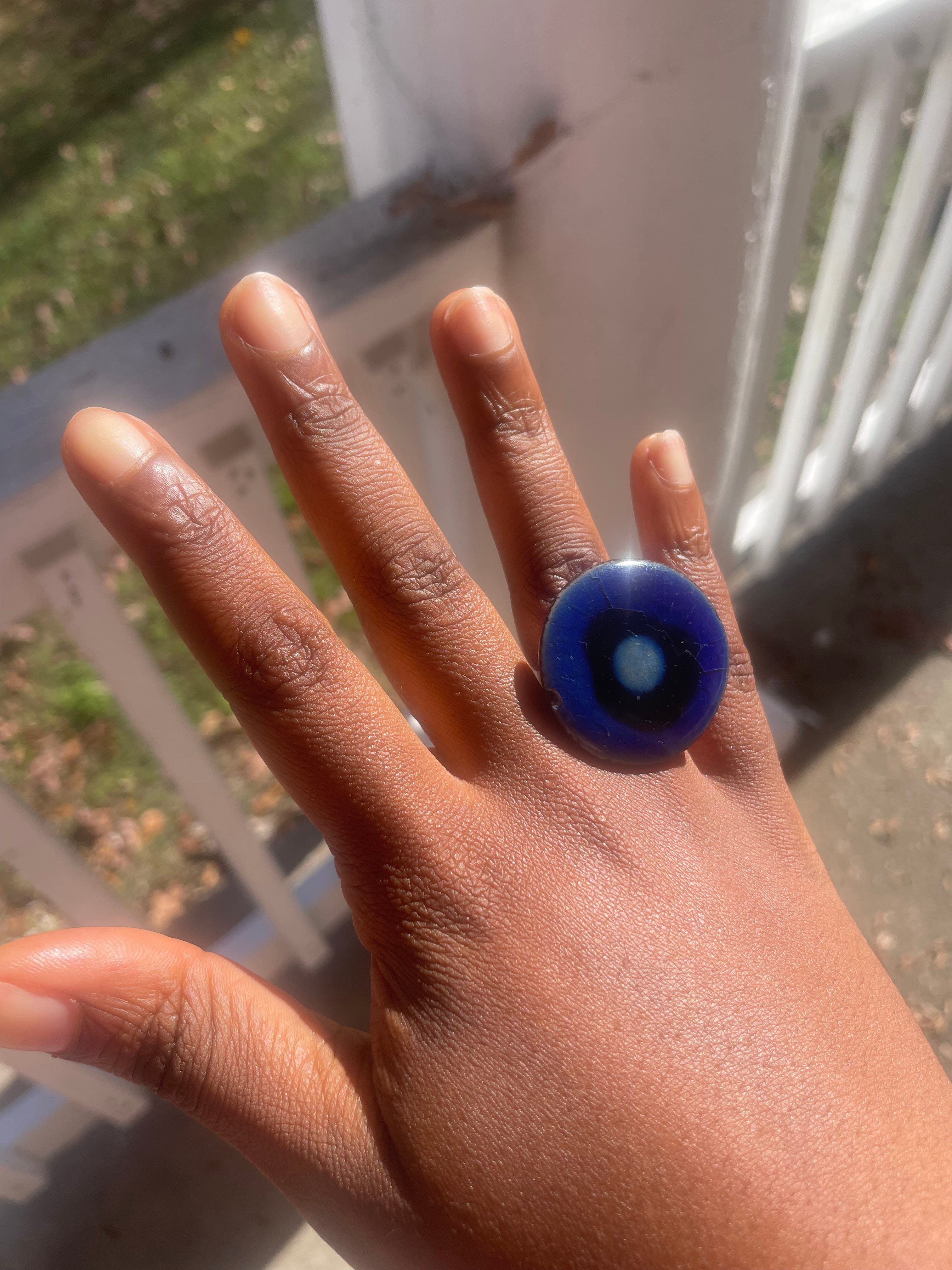
“I feel like your ring is staring at me,” 🧿👄🧿 said. I don’t know what I offered in response. I probably laughed. A year and some change after the fact and I have not really stopped laughing since.
Ultimately, a tendency towards exhibitionism as well as the desire to disappear both come from a place of a complicated relationship with (fear of) visibility. (One guess as to which side the author of this piece tends to come down on.) To return to The Bluest Eye, to Pecola’s delusion of blue-eyed confidence:
[Pecola’s imaginary friend:] I’d just like to do something else besides watch you stare in that mirror.
[Pecola:] You’re just jealous.
“If the mirror becomes seducing and reassuring,” Bonomi writes, “as in the myth of Narcissus, it is because it permits us to regain some control over our visibility.”
Sarah Blanchette writes of the way in which American society traits Black girls “as ‘non-children’ unworthy of protection and outside the realm of ‘child/human’” with “Black girls often sacrific[ing] their right to childhood innocence to survive the conditions of white supremacy.”
Blanchette goes on to argue that a character like Pecola manages to survive the unsurvivable “by drawing on distinctly childlike coping mechanisms, such as her deflection of mature topics and her use of make-believe, including her imaginary friend…survives the conditions of white supremacy designed to destroy her sense of self and childhood innocence by relying on her Black girlhood subjectivity…even if paradoxically it is Pecola’s right to childhood innocence that is under siege.”
Blanchette points out how it is through “consuming symbols of white girlhood” like enjoying the aforementioned Shirley Temple cup, or eating Mary Jane candies, that she “resists being positioned as non/child.”
Blanchette does not frame Pecola’s desire for blue eyes as a similar act of consumption, but as an act of make-believe: I might slide past both categorizations and return to Bonomi’s re-telling of a client case wherein a client grappling with insecurity begins “to wear dark glasses…now feeling safe because the people’s eyes could not reach her.”
The primary function of sunglasses is to make it easier to see. Literally, given the name, in blocking out UV rays, and also as a by-product of obscuring the face and eyes. At risk of misinterpretation, might a Black girl crave a magical pair of mystical blue orbs to fulfill the same purpose? Might such an irrational want betray a genuine orientation towards survival, born of genuine will?
“What is subjectively felt is that we would not survive if our most intimate desires, hopes, and emotions were to be made visible,” writes Bonomi. But in relegating the needs of the ego to the realm of the subjective, maybe psychoanalysis begins to fail here, fails to truly reckon with the lived experience of marginalized people, particularly Black people, especially Black girls, women, and femmes: it’s not paranoia if they’re really out to get you. You can’t say Pecola was afraid for nothing.
Lord knows I myself love wearing shades in the club in addition to the nazar on my person, find it harder to go out without both. Who knows what color eyes like mine might be, after a certain point in the night.